English
 日本語
日本語 한국어
한국어 français
 Deutsch
 Español
 italiano
 русский
 العربية
 ไทย
ไทย हिंदी
हिंदी
LEDs (Light Emitting Diodes), with their outstanding advantages of high luminous efficiency, low energy consumption, and long service life, have become widely used in large-scale displays, traffic signals, general lighting, automotive lighting, and even cutting-edge fields such as Mini/Micro LEDs. As LED devices continue to evolve toward higher power, smaller size, and higher integration, the encapsulation materials must withstand increasingly demanding challenges from light, heat, humidity, and mechanical stress — placing ever-stricter requirements on the transparency, heat resistance, weatherability, and processability of encapsulation adhesives.
Cycloaliphatic epoxy resins — particularly Tetra New Materials' TTA21 — are widely used in LED and optical device encapsulation adhesives thanks to their excellent processability, high Tg, and good weatherability.

TTA21's molecular structure contains no benzene ring; the epoxy group is directly connected to the cycloaliphatic backbone.
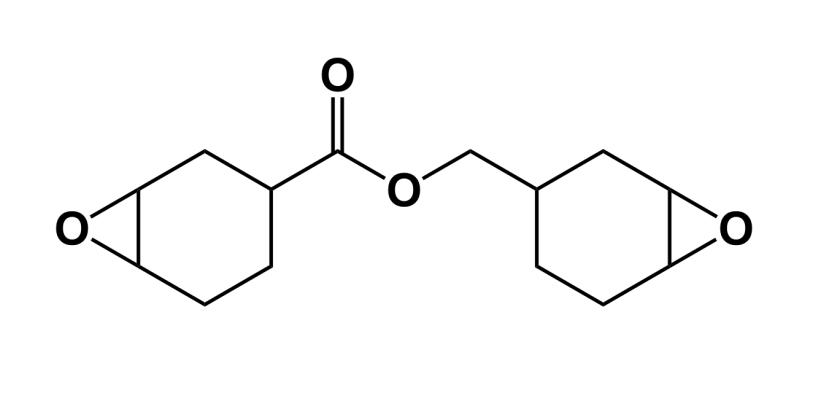
This structural feature directly gives it several core advantages over conventional bisphenol A-type epoxy resins:
· Low viscosity: Low molecular weight and low viscosity at room temperature give it good flowability, facilitating smooth dispensing and potting processes.
· High Tg: The rigid cycloaliphatic structure and high crosslink density result in a significantly higher glass transition temperature (Tg) after curing compared to similar bisphenol A-type systems. This allows better resistance to thermal shock during LED device operation and reflow soldering, with reduced long-term performance degradation.
· Excellent electrical properties: Extremely low chlorine content, along with high volume resistivity and stable dielectric properties in the cured product, meets the insulation reliability requirements of LED and optical device encapsulation.
· High transparency: The cured product has high light transmittance, making it an ideal base resin for optical-grade encapsulation adhesives, lens adhesives, and LED bracket dispensing applications.
· Excellent weatherability: Without the aromatic conjugated system found in bisphenol A structures, UV absorption is significantly reduced, making the material resistant to yellowing under prolonged light exposure or high-temperature environments — particularly suitable for LED encapsulation applications with stringent requirements for light transmittance and color stability.
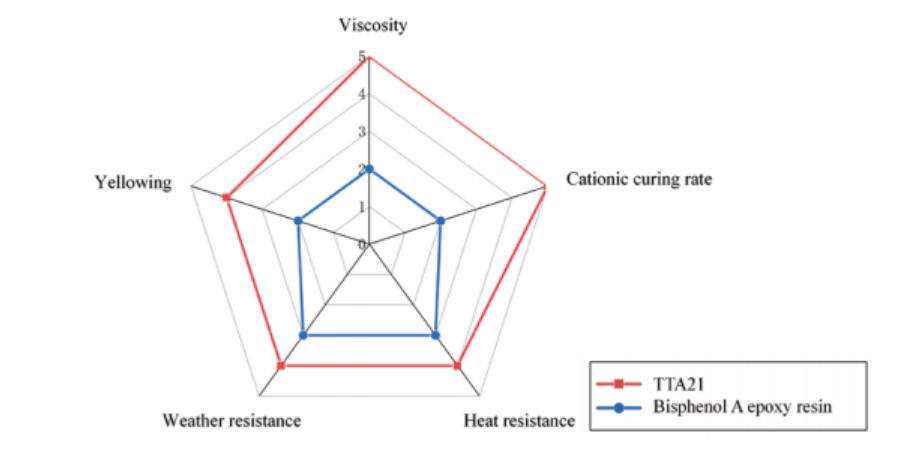
Thanks to the performance advantages above, TTA21 delivers outstanding results in LED encapsulation and related optical applications:
· SMD LED encapsulation adhesive: TTA21's high Tg and heat resistance help devices withstand thermal shock during reflow soldering and long-term operation, reducing the risk of cracking and delamination caused by internal stress; it also maintains stable optical performance under long-term light exposure.
· Through-hole (DIP) LED encapsulation adhesive: Its low viscosity and fast-curing properties help improve encapsulation efficiency and shorten production cycle times, making it suitable for large-scale production needs, while also enhancing the heat resistance of LED lamps to meet more demanding application environments.
Tetra New Materials' TTA21 is a high-performance cycloaliphatic epoxy resin product specifically developed for the LED encapsulation field, featuring core characteristics such as low viscosity, high Tg, and excellent heat resistance and weatherability. We provide integrated technical support from product selection to application adaptation. If you are looking for a high-performance cycloaliphatic epoxy resin for LED encapsulation or weather-resistant optical adhesives, please feel free to contact us.
This is the first one.