English
 日本語
日本語 한국어
한국어 français
 Deutsch
 Español
 italiano
 русский
 العربية
 ไทย
ไทย हिंदी
हिंदी
In today’s era of deep integration between the “dual-carbon” goals (carbon peaking and carbon neutrality) and intelligent manufacturing, the green transformation of industry has evolved from a conceptual vision to practical implementation. As the “surface engineering” of the manufacturing industry, coating processes—known for high energy consumption and VOC emissions—have become a key link in industrial carbon reduction.
The rise of ultraviolet (UV) curing technology, supported by advancements in specialty resin and chemical formulations, brings disruptive advantages such as “instant curing, low-carbon sustainability, and high efficiency.” It is accelerating the reconstruction of coating technology and application logic, emerging as a vital “green engine” in this industrial revolution.
Traditional thermally cured coatings rely on high-temperature baking (typically 60–180°C) to initiate resin crosslinking and film formation. This process not only consumes significant energy and time (curing often takes minutes to hours) but may also deform or damage heat-sensitive substrates.
The core mechanism of UV curing, by contrast, uses ultraviolet energy to directly trigger the “energy switch” within materials — the photoinitiator. When exposed to UV light, photoinitiators absorb energy and decompose into reactive radicals or cations, rapidly initiating polymerization and crosslinking reactions. This transforms the liquid coating into a solid film within seconds.
A typical UV-curable formulation consists of a prepolymer (e.g., epoxy acrylate), reactive diluent (monomer), photoinitiator, and additives. In certain applications, such as can coating epoxy resin systems, these components work synergistically to achieve fast and efficient curing performance. Under 200–400 nm UV light, the photoinitiator generates active species that induce chain reactions between the prepolymer and monomers, forming a three-dimensional crosslinked structure. This process requires no heat, and the reaction rate can be precisely controlled by adjusting light intensity and initiator type—completely eliminating the time and temperature constraints of traditional thermal curing.
Compared with conventional thermal curing, UV curing delivers across-the-board benefits—in efficiency, energy use, environmental performance, and coating quality.
Revolutionary Speed: Curing in seconds, production 10× faster.
Unlike thermal curing, which requires long cooling and leveling times, UV curing achieves “coat and dry instantly,” reducing curing from minutes to seconds and dramatically shortening production cycles.
For instance, smartphone shell coating lines using UV curing have increased throughput by over 30%, while cutting labor and equipment costs.
Low-Temperature Energy Savings: Goodbye to energy-hungry ovens.
UV curing requires no substrate or coating heating, using only 10–20% of the energy consumed by thermal curing.
In wood coatings, for example, traditional methods require multiple baking cycles at 120–180°C, while UV curing works at room temperature—reducing energy use from ~200 MJ/m² to just 20 MJ/m², helping manufacturers achieve carbon-reduction targets.
Eco-Friendly: Near-zero VOC emissions.
Solvent-based coatings emit large quantities of volatile organic compounds (VOCs) during curing, polluting the environment and posing safety risks.
UV coatings use reactive monomers as diluents with virtually no solvent evaporation, reducing VOC emissions by over 90%—fully aligned with “zero-VOC” policy trends.
Enhanced Performance: Dense, durable, and multifunctional films.
UV-cured coatings form tightly crosslinked, uniform films with superior adhesion, wear resistance, and chemical durability.
For example, a UV protective coating for automotive bearings only 5–10 μm thick (vs. 20–30 μm for conventional coatings) achieves equal or better corrosion and abrasion resistance.
Smart Manufacturing Integration: Seamless fit for automated lines.
UV curing systems—using UV LED or mercury lamps—can easily integrate with robotic applicators and in-line inspection tools.
Compatible with roll-to-roll, roll coating, and spraying methods, they provide a flexible technological foundation for Industry 4.0 production environments.
With these advantages, UV curing technology has achieved large-scale adoption in advanced manufacturing and continues expanding into emerging sectors.
3C Electronics and Home Appliances: The guardian of aesthetics and functionality.
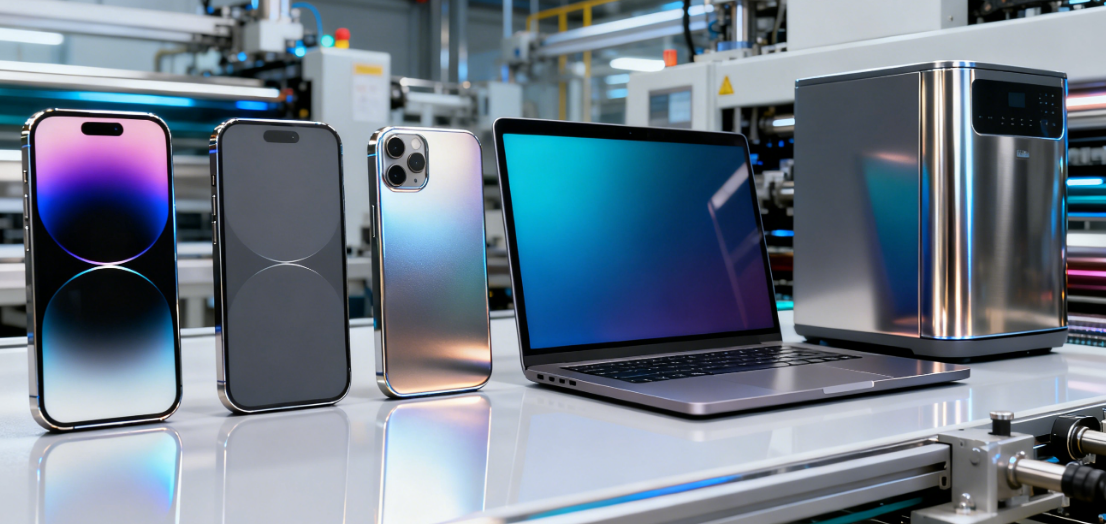
In smartphones, laptops, and smart appliances, UV coatings deliver glossy, matte, gradient, or metallic finishes while maintaining precise dimensional stability.
A leading smartphone brand’s adoption of a UV basecoat + topcoat system shortened coating cycles from 15 minutes to just 3 minutes and raised yield rates above 99%.
Wood and Furniture: The green upgrade of traditional craftsmanship.
Wood coatings have long struggled with slow drying and high VOC emissions. UV curing solves both.
Flooring and cabinetry finished with UV coatings can be “painted and installed immediately,” achieving pencil hardness of 2H–3H and scratch resistance surpassing polyurethane coatings.
Today, over 40% of production lines at major furniture manufacturers in China employ UV coating systems.
New Energy Batteries: A key enabler of safety and efficiency.
In high-energy-density lithium batteries, cell insulation determines overall safety.
Traditional polyimide films require high-temperature lamination and often suffer from poor flexibility and bubble formation.
UV-curable insulating coatings, applied at room temperature with thicknesses of just 10–20 μm, achieve grade-0 adhesion (no peeling), withstand −40°C to 120°C, and have dielectric strengths over 50 kV/mm.
They are now supplied to top manufacturers such as CATL and BYD.
Automotive Components: Balancing lightweight and durability.
Parts such as chassis, bearings, and lamp brackets must resist corrosion and wear while remaining lightweight.
UV coatings achieve “thin-film, thick performance” with 5–15 μm layers and no heat distortion, suitable for aluminum alloys and composites.
A German automaker’s adoption of UV anticorrosion coatings extended bearing life by 30% and improved production efficiency by 25%.
Despite its advantages, widespread UV curing adoption faces three main challenges:
1、Curing Uniformity:
UV light has limited penetration in dark or opaque substrates, causing under-cured zones and tackiness.
Solutions include developing high-transparency resins, multi-wavelength LED sources (e.g., 365 + 395 nm combinations), and scanning-type curing systems to ensure full energy coverage.
2、Substrate Compatibility:
Low-surface-energy materials (e.g., PP, PE) or pigmented coatings absorb UV light strongly, requiring sensitizers or cationic systems (which can cure nonpolar substrates) but at higher cost.
3、Cost Pressure:
UV LEDs, high-power mercury lamps, and specialty raw materials (photoinitiators, oligomers) remain costlier than conventional alternatives.
However, as production scales up, UV equipment costs have dropped by ~40% in the past five years, and domestic initiators are approaching global performance levels.
At the intersection of carbon neutrality and intelligent manufacturing, the potential of UV curing is far from fully realized, especially as innovations in material tetra continue to expand its application boundaries.
With continuous progress in supporting equipment (e.g., smart UV light sources, online monitoring), materials innovation (e.g., bio-based oligomers, heavy-metal-free additives), and stricter environmental standards (such as Emission Standards of Air Pollutants for the Coating, Ink, and Adhesive Industry), UV curing is expanding from light industry into aerospace, new energy systems, and biomedical fields.
In the foreseeable future, UV curing technology will not only drive the coating industry’s transition from “high energy, high emissions” to “green and intelligent,” but also serve as a cornerstone technology for achieving global carbon neutrality.
In this transformation driven by both technology and sustainability, UV curing is using “light” as its brush to redraw the future landscape of industrial coatings.