English
 日本語
日本語 한국어
한국어 français
 Deutsch
 Español
 italiano
 русский
 العربية
 ไทย
ไทย हिंदी
हिंदी
In 2026, electronics and industrial adhesive engineers are caught in a familiar mechanical design trap. The heat resistance and electrical insulation targets that modern applications demand — dry-type transformer insulation, power electronics encapsulation, flexible printed circuit board adhesives, and composite structural components — require high crosslink density in the cured epoxy network. But high crosslink density comes with a mechanical penalty: the cured network becomes brittle, losing the strain tolerance that allows it to absorb the bending, vibration, and thermal cycling stress of real operating conditions without cracking. A micro-crack in an FPC adhesive layer is not a cosmetic defect — it is a failure path for moisture ingress, a stress concentration that propagates under repeated flexing, and a potential open circuit in a high-density interconnect that cannot be repaired in the field.
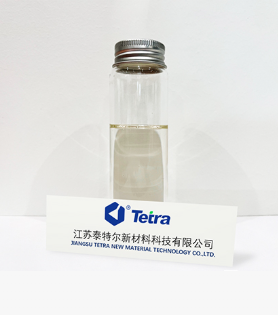
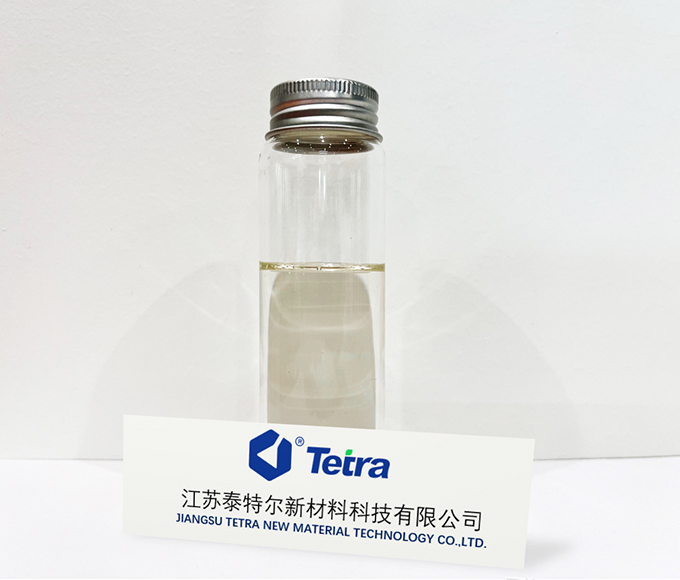
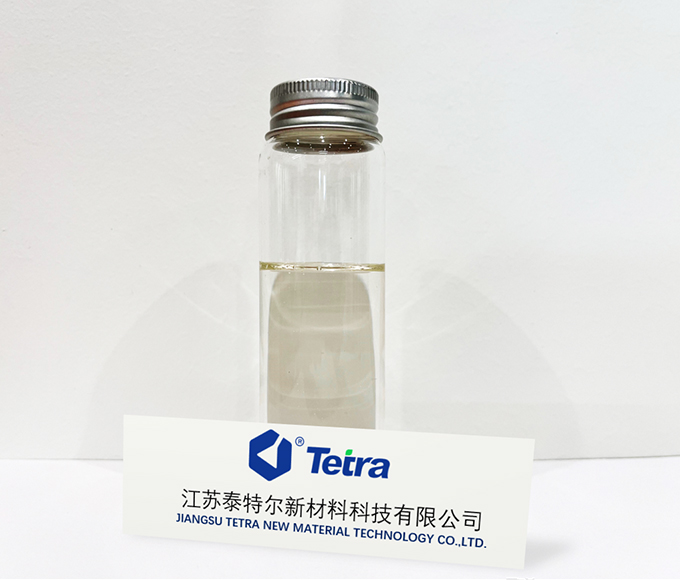
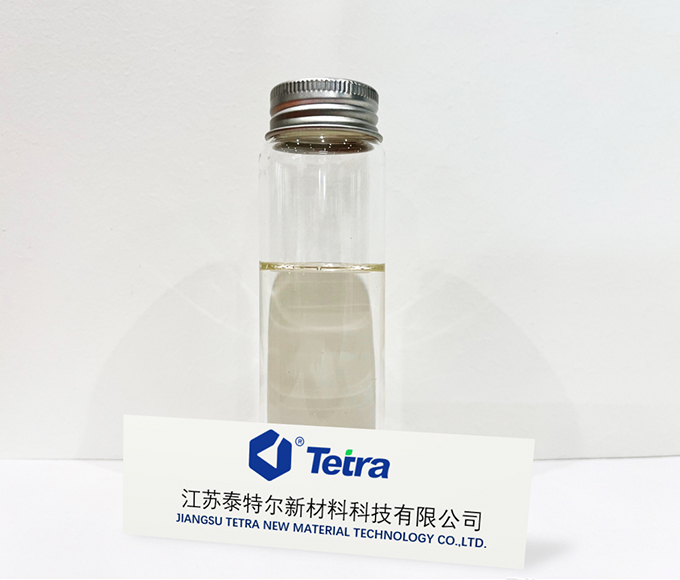
The 1 2 cyclohexane diol polymer architecture of TTA3150 — CAS 244772-00-7, Poly[(2-oxiranyl)-1,2-cyclohexanediol]-2-ethyl-2-(hydroxymethyl)-1,3-propanediol ether, supplied by Tetrawill — addresses this mechanical design trap through internal plasticization: the polymeric ether backbone of the molecule introduces a flexible segment into the cured epoxy network that improves toughness and bending tolerance without sacrificing the high Tg, heat resistance, and electrical reliability that the application requires. Tetrawill positions TTA3150 as a typical cycloaliphatic epoxy resin with high transparency, high heat resistance, high Tg, excellent weather resistance, and excellent electrical properties — with very low chloride ions and chloride salts — for use in composite materials, electrical insulation materials, electronic adhesives, and powder coatings. The combination of these properties makes it a practical flexible epoxy resin building block for 2026 programs where brittleness is the failure mode that is limiting product reliability.
Understanding the mechanical failure mechanism that TTA3150 addresses is the foundation for specifying it correctly and validating its performance in the target application.
The mechanical properties of a cured epoxy network are determined by the crosslink density — the number of chemical crosslinks per unit volume of the cured polymer. High crosslink density increases the Tg, the modulus, and the hardness of the cured network, which is why high-performance electrical insulation and heat-resistant adhesive applications specify high-functionality epoxy resins and stoichiometric hardener systems that maximize the crosslink density of the cured product.
The penalty for high crosslink density is reduced chain mobility between crosslink points. In a highly crosslinked network, the polymer chains between crosslinks are short and cannot deform significantly before the stress exceeds the bond strength and a crack initiates. The result is a cured material with high hardness and high Tg but low elongation at break, low impact resistance, and low resistance to crack propagation — the mechanical profile that engineers describe as brittle.
For applications where the cured epoxy is subjected to bending, vibration, or thermal cycling — FPC adhesive layers that flex with the circuit, encapsulants that experience thermal expansion mismatch stress, and composite structures that absorb impact loads — brittleness is not an acceptable mechanical profile. The crack that initiates under the first thermal cycle or the first bending event propagates with each subsequent cycle, producing a progressive failure that is not detectable until the assembly fails electrically or mechanically.
The engineering requirement in 2026 is not to choose between heat resistance and toughness — it is to find the formulation architecture that delivers both simultaneously. The target is a cured network with a Tg high enough to maintain its mechanical and electrical properties at the operating temperature of the device, a modulus high enough to provide the dimensional stability that the application requires, and a toughness high enough to absorb the bending, vibration, and thermal cycling stress without cracking.
Tetrawill positions TTA3150 for composite materials, electrical insulation materials, electronic adhesives, and powder coatings — the application categories where this combination of heat resistance, electrical reliability, and mechanical durability is the primary design requirement.
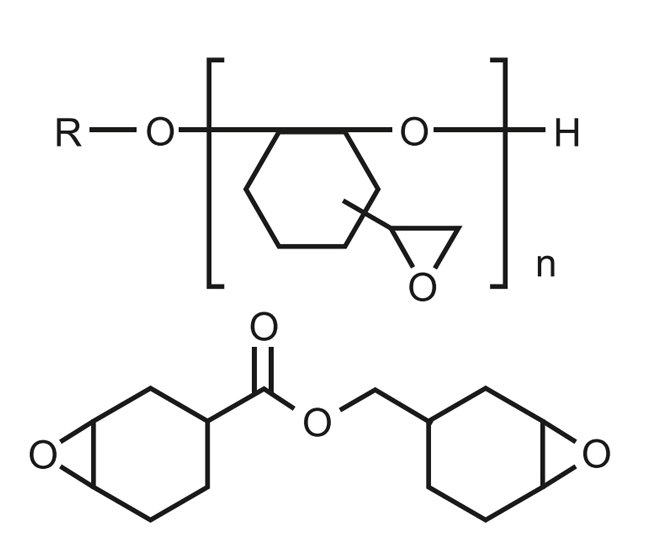
The internal plasticization mechanism of TTA3150 derives from the polymeric ether backbone of the Poly[(2-oxiranyl)-1,2-cyclohexanediol]-2-ethyl-2-(hydroxymethyl)-1,3-propanediol ether molecule — a structure that introduces flexible ether linkages and aliphatic chain segments between the cycloaliphatic epoxide groups that participate in the crosslinking reaction.
In a conventional difunctional epoxy system — bisphenol-A epoxy cured with an anhydride or amine hardener — the polymer chains between crosslink points are relatively short and rigid, producing the brittle mechanical profile described above. When TTA3150 is incorporated into the formulation, the polymeric ether backbone of the molecule becomes part of the cured network between crosslink points. The ether linkages and aliphatic chain segments in this backbone have higher chain mobility than the rigid aromatic or cycloaliphatic segments of conventional epoxy backbones, allowing the network to deform more before crack initiation — the mechanical effect of internal plasticization.
The key distinction between internal plasticization — achieved by incorporating a flexible segment into the epoxy backbone — and external plasticization — achieved by adding a non-reactive plasticizer to the formulation — is that internal plasticization does not reduce the Tg of the cured network as severely as external plasticization. A non-reactive plasticizer acts as a diluent in the cured network, reducing the crosslink density and the Tg in proportion to the plasticizer loading. An internally plasticizing epoxy like TTA3150 contributes its flexible segments to the cured network while also contributing its epoxide groups to the crosslinking reaction, maintaining a higher crosslink density and a higher Tg than an equivalent loading of non-reactive plasticizer would produce.
Tetrawill notes that TTA3150's terminal epoxy groups have similar reactivity to related glycidyl ether epoxy resins and can be cured with anhydride, phenol, amine, and cationic curing agents. This cure chemistry flexibility is a practical advantage for formulation development: the hardness versus flexibility balance of the cured network can be tuned by selecting the curing agent type and the stoichiometric ratio, without changing the base resin.
Tetrawill's product page provides Tg data for TTA3150 cured with three different anhydride hardeners — methyl-hexahydrophthalic anhydride (MHHPA), methyl-tetrahydrophthalic anhydride (MTHPA), and methylnadic anhydride (MNA) — with Tg values of 234°C, 226°C, and 241°C respectively. These data points demonstrate the range of thermal performance achievable with TTA3150 across different cure chemistries, and provide the starting point for the cure matrix development that a formulation qualification program requires.
An important practical note from Tetrawill's product page: the curing of TTA3150 with MHHPA produces excellent transparency and high heat resistance, while curing with MTHPA produces slightly lower Tg and yellow color, and curing with MNA produces the highest Tg but the lowest thermal decomposition temperature and a brown translucent color. For applications where optical clarity is a requirement — LED encapsulation, optical adhesives — the MHHPA cure system is the appropriate starting point. For applications where maximum Tg is the primary requirement and color is not critical — electrical insulation castables, structural composites — the MNA cure system provides the highest thermal performance.
Tetrawill explicitly highlights very low chloride ions and chloride salts as a key property of TTA3150. For electronic adhesive and electrical insulation applications where ionic contamination in the encapsulant can form conductive pathways in the presence of moisture — increasing leakage current and accelerating corrosion of metal contacts and conductor traces — the low chloride content of TTA3150 is a reliability-critical material property. The cycloaliphatic epoxy backbone of TTA3150 — synthesized without the epichlorohydrin route that introduces residual chlorine into glycidyl amine and bisphenol-A epoxy systems — is the structural basis for the low ionic contamination that electronics-grade applications require.
Qualifying TTA3150 for a flexible epoxy resin or epoxy toughening agent application requires locking the material specifications that determine both the formulation performance and the batch-to-batch consistency of the ingredient.
| Parameter | Specification | Relevance to Formulation |
|---|---|---|
| CAS number | 244772-00-7 | Identity confirmation for regulatory and SDS compliance |
| Content (assay) | 95.0% minimum | Determines functional group density per gram of material |
| Epoxy equivalent weight (EEW) | 170 to 200 g/eq | Determines stoichiometric mix ratio with hardener and crosslink density |
| Chroma (APHA) | 50 maximum | Determines color contribution to the cured system — relevant for optical applications |
| Softening point | 70 to 90°C | Determines processing temperature requirement and solid-state handling |
Curing agent selection is the primary lever for tuning the hardness versus flexibility balance of the TTA3150-based formulation. The three anhydride cure systems documented on Tetrawill's product page — MHHPA at 234°C Tg, MTHPA at 226°C Tg, and MNA at 241°C Tg — provide the Tg range for anhydride-cured systems. Amine and phenolic cure systems will produce different Tg and mechanical property profiles that must be characterized experimentally for the specific application.
Stoichiometric ratio adjustment — varying the ratio of epoxy equivalents to hardener equivalents — is the secondary lever for tuning the crosslink density and the hardness versus flexibility balance. A sub-stoichiometric hardener loading produces a resin-rich network with lower crosslink density, lower Tg, and higher toughness. A stoichiometric or slightly super-stoichiometric loading produces the maximum crosslink density and Tg. The optimal ratio for a specific application must be determined by a formulation ladder study — testing at 90%, 100%, and 110% of stoichiometric hardener loading — measuring Tg, modulus, elongation at break, and impact resistance at each ratio.
Appearance requirement confirmation is a practical step that is often overlooked in formulation development. Tetrawill's product page notes that the cured color of TTA3150 can be brown and translucent in the high-heat-resistance MNA cure system — a color that is acceptable for electrical insulation castables and structural composites but not for LED encapsulation or optical adhesive applications. Confirm the appearance requirement of the specific application before selecting the cure system.
For FPC adhesive applications where the adhesive layer must maintain its bond strength and electrical insulation performance through thousands of bending cycles — the flex fatigue requirement that distinguishes FPC adhesives from rigid PCB adhesives — the internal plasticization of TTA3150 provides the toughness and bending tolerance that prevents crack initiation at the adhesive-substrate interface. The low chloride content supports the electrical reliability requirement of the FPC assembly, and the high Tg potential — up to 241°C with MNA cure — provides the thermal stability that prevents softening during reflow soldering and high-temperature operation.
For FPC encapsulation applications where the encapsulant must protect the circuit from moisture and mechanical damage while flexing with the circuit, the combination of low APHA color (50 maximum), high Tg, and low ionic contamination makes TTA3150 a strong candidate base resin for formulation development.
Tetrawill lists electronic adhesives and electrical insulation materials as key application fields for TTA3150. For electronic adhesive applications — die attach, underfill, and component bonding — the combination of high Tg, low chloride content, and tunable hardness versus flexibility balance provides the reliability profile that electronics assembly requires. For electrical insulation casting applications — dry-type transformer insulation, motor coil impregnation, and power electronics encapsulation — the high Tg potential and excellent electrical properties (arc resistance and electric trace resistance) provide the insulation performance that high-voltage applications require.
Tetrawill lists composite materials and powder coatings as application fields for TTA3150. For composite applications — carbon and glass fiber reinforced structures — the combination of high Tg, excellent weather resistance, and tunable mechanical properties provides the structural performance and durability that outdoor and high-temperature composite applications require. For powder coating applications — where the coating must maintain its appearance and adhesion through thermal cycling and UV exposure — the excellent weather resistance and low APHA color of TTA3150 provide the optical stability and durability that outdoor coating applications require.
Step one: define the failure mode. Identify whether the cracking failure is brittle fracture — a single crack event under a single load application — or fatigue cracking — progressive crack growth under repeated loading cycles. Brittle fracture requires an increase in the fracture toughness of the cured network. Fatigue cracking requires an increase in the elongation at break and the resistance to crack propagation. Both failure modes are addressed by the internal plasticization of TTA3150, but the formulation optimization strategy — curing agent selection, stoichiometric ratio, and filler loading — differs between the two.
Step two: set the performance targets. Define the minimum acceptable Tg, the target modulus and elongation at break, the peel and shear strength requirements, the dielectric strength and insulation resistance targets, and the appearance requirement. These targets are the acceptance criteria for the formulation development and the production QC.
Step three: build the formulation matrix. Test TTA3150 with at least two cure chemistries — for example, MHHPA for transparency and high Tg, and an amine system for faster cure and different mechanical profile — and at least three stoichiometric ratios for each cure chemistry. Measure Tg, modulus, elongation at break, impact resistance, and peel or shear strength at each formulation point.
Step four: validate the performance. Perform DSC or DMA for Tg, bending and flex fatigue testing at the target bend radius and cycle count, impact testing, thermal cycling from the minimum to maximum operating temperature for the required number of cycles, and adhesion retention after thermal cycling. Measure electrical leakage and insulation resistance after moisture soak if the application requires electrical reliability validation.
Step five: lock the incoming QC specification. Define the acceptance criteria for EEW, chroma, softening point, and chloride content based on the TTA3150 specification and the formulation sensitivity analysis. Include TTA3150 in the incoming COA check and the in-house viscosity and cure response calibration checks that confirm batch-to-batch consistency before production use.
| Cost Item | High-Crosslink-Density Brittle System | TTA3150 Internally Plasticized System |
|---|---|---|
| Cracking-driven scrap rate | Higher — brittle fracture under bending or thermal cycling | Lower — internal plasticization improves toughness and crack resistance |
| Field failure rate from flex fatigue | Higher — fatigue cracking under repeated bending | Lower — improved elongation at break reduces fatigue crack initiation |
| Delamination from thermal cycling | Higher — high residual stress from brittle network | Lower — improved toughness reduces delamination at interface |
| Electrical leakage from ionic contamination | Higher — uncontrolled chloride content | Lower — very low chloride ions and chloride salts |
| Requalification frequency from lot variation | Higher — uncontrolled EEW and softening point | Lower — defined EEW 170 to 200 g/eq and softening point 70 to 90°C |
| Warranty return rate | Higher — cracking and delamination failures generate field returns | Lower — improved mechanical durability reduces return rate |
In 2026, the epoxy formulation challenge for flexible electronics, electrical insulation, and composite applications is not choosing between heat resistance and toughness — it is finding the resin architecture that delivers both simultaneously. The 1 2 cyclohexane diol polymer backbone of TTA3150 (CAS 244772-00-7) provides the internal plasticization mechanism that resolves this challenge: a polymeric ether structure that introduces flexible segments into the cured epoxy network, improving toughness and bending tolerance without the Tg penalty of external plasticization, while maintaining the high heat resistance — up to 241°C Tg with MNA cure — and excellent electrical properties that demanding applications require.
Tetrawill's TTA3150 — 95.0% minimum content, 170 to 200 g/eq epoxy equivalent weight, 50 APHA maximum chroma, 70 to 90°C softening point, and very low chloride ions and chloride salts — provides the specification clarity and electronics-grade purity that FPC adhesive, electronic encapsulation, electrical insulation, and composite formulation programs require. Visit the Tetrawill TTA3150 product page to review the full specification and submit your application requirements for a matched formulation recommendation and quotation.
Visit the Tetrawill TTA3150 product page to review the full specification, then submit the following details to receive a matched formulation recommendation and quotation:
| Parameter | What to Provide |
|---|---|
| Work condition | Application (FPC adhesive, encapsulation, insulation castable, or powder coating), bend and flex profile, operating temperature range, thermal cycling requirement, humidity and chemical exposure |
| Quantity | Lab sample, pilot batch, or monthly demand |
| Size and spec | Target Tg, hardness and flexibility targets, cure type limits (maximum cure temperature and time), appearance requirement (clear or translucent), filler usage (yes or no) |
| Target metrics | Impact strength, flex fatigue life, peel and shear strength, dielectric requirements, allowable crack rate and scrap rate |
| Current problem | Brittle cracking, delamination after thermal cycling, insufficient bendability, inconsistent cure or lot variation |
1. What is CAS 244772-00-7?
CAS 244772-00-7 is the registry number for Poly[(2-oxiranyl)-1,2-cyclohexanediol]-2-ethyl-2-(hydroxymethyl)-1,3-propanediol ether, supplied by Tetrawill as TTA3150. It is a typical cycloaliphatic epoxy resin with a polymeric ether backbone that provides internal plasticization in cured epoxy networks. Tetrawill describes it as having high transparency, high heat resistance, high Tg, excellent weather resistance, and excellent electrical properties — with very low chloride ions and chloride salts — for use in composite materials, electrical insulation materials, electronic adhesives, and powder coatings. Published specifications include 95.0% minimum content, 170 to 200 g/eq EEW, 50 APHA maximum chroma, and 70 to 90°C softening point.
2. How does TTA3150 compare with standard bisphenol-A epoxies or reactive diluents for toughening?
Bisphenol-A epoxies are strong and widely qualified but can be brittle in high-crosslink-density formulations without a toughening strategy — the aromatic backbone provides rigidity but limited chain mobility between crosslink points. Reactive diluents reduce viscosity and can improve processability, but may reduce Tg and mechanical strength if not selected carefully, because they dilute the crosslink density of the cured network. TTA3150 provides a different toughening mechanism — internal plasticization through the polymeric ether backbone — that improves toughness and bending tolerance while contributing its epoxide groups to the crosslinking reaction, maintaining a higher Tg than an equivalent loading of reactive diluent or non-reactive plasticizer would produce.
3. What is the ROI of using an epoxy toughening approach with TTA3150?
The payback comes from three measurable sources. Lower cracking-driven scrap rate — fewer brittle fracture and fatigue cracking failures during assembly and in service reduce the resin, labor, and machine time cost of scrap and rework. Lower field failure rate — improved toughness and bending tolerance reduce the delamination and cracking failures that generate warranty returns and liability exposure. More stable production — the defined EEW, softening point, and chloride content specifications of TTA3150 reduce the batch-to-batch variation that causes process drift and requalification events.
4. Do we need to modify our process to use TTA3150?
The mixing and dispensing equipment typically does not require modification. The primary process adjustments are cure chemistry selection — choosing between MHHPA for transparency and high Tg, MTHPA for a slightly lower Tg and yellow color, MNA for the highest Tg with brown translucent color, or amine and phenolic systems for different mechanical profiles — and cure schedule optimization for the selected cure chemistry. The softening point of 70 to 90°C means that TTA3150 is a solid at room temperature and requires heating to above the softening point for dispensing — confirm the dispense temperature and the mixing procedure before the first production trial. Incoming QC checks for EEW, chroma, and softening point should be added to the material acceptance procedure.
5. What parameters should I provide for correct TTA3150 selection and quoting?
Target Tg and mechanical window (minimum Tg, target modulus, minimum elongation at break, and impact resistance), cure chemistry constraints (maximum cure temperature and time, preferred curing agent family), bend radius and flex cycle requirement for FPC or flexible encapsulation applications, electrical insulation targets (dielectric strength, insulation resistance, and leakage current limit), chloride and ionic contamination limits, appearance requirement (clear, translucent, or color-tolerant), filler usage (yes or no, and target viscosity after filler addition), monthly volume and delivery schedule, and the primary failure mode being addressed — brittle cracking, flex fatigue delamination, thermal cycling damage, or inconsistent cure response between lots.